
Water Damage Restoration Cost Guide: What Upper West Side Homeowners Pay in 2026
Water damage restoration on the Upper West Side typically runs between $4,200 and $11,800 for a standard single-room incident in 2026, with Category 3 sewage backups pushing costs past $15,000 once rebuild work begins. Those figures are nearly double what national cost guides publish, and the gap exists because Manhattan pricing follows different rules than suburban or Sun Belt markets. If you’re standing in a wet apartment right now and want a straight answer on what it’ll take, call (845) 305-5737. Otherwise, here’s the honest math we’ve learned after fifteen years of pulling water out of pre-war co-ops and postwar high-rises between 59th and 110th.
Key Takeaways
- Upper West Side restoration costs run 60-110% above national averages due to co-op requirements, elevator access fees, and Manhattan labor rates.
- Category 1 clean water starts around $4,200 per room; Category 3 sewage backup with rebuild work regularly exceeds $15,000.
- Splitting extraction from rebuild into two contractor contracts typically adds 20-35% to project totals through mobilization fees and scope gaps.
- Standard HO-6 condo policies cover sudden water damage but frequently exclude slow leaks, seepage, and pre-existing conditions - the three most common Upper West Side claims.
Why Upper West Side Costs Don’t Match National Averages
The $3,000 national average you’ll find on most restoration cost guides doesn’t survive contact with a Riverside Drive co-op board. In a pre-war building on West End Avenue, that number won’t cover the intake paperwork. Here’s what actually drives pricing in this neighborhood.
First, co-op and condo boards on the Upper West Side almost universally require restoration contractors to submit certificates of insurance showing $1M to $2M in general liability coverage before work begins. That’s not a formality. Many buildings require the contractor to list the board, the managing agent, and sometimes the individual shareholder as additional insureds on the policy. A contractor who doesn’t carry that coverage, or whose carrier won’t process the endorsement quickly, never gets through the door. Contractors who do carry it pay real money for that coverage and price accordingly.
Second, elevator access in Upper West Side high-rises comes with freight elevator reservations, limited operating hours without a surcharge, and padding deposits that can run $300 to $800 per day depending on the building. Restoration crews move hundreds of pounds of equipment, wet drywall, and debris through those elevators. A job that takes two days in a Westchester house might take four in a doorman building where the service elevator is only available 9 a.m. to 4 p.m., and where the super requires protective floor covering in the hallways.
Third, Manhattan labor rates are simply higher. Restoration technicians, plumbers, and carpenters who work in this neighborhood command wages and benefits that reflect the cost of living here, and those costs land on every invoice. We’ve been doing this work since 2010, and the labor multiplier hasn’t moved downward a single year.
Upper West Side Cost Breakdown by Water Category
Not all water damage is the same, and the cost difference depends on what’s in the water, not just how much of it there is. Here’s how pricing actually breaks down in Upper West Side apartments and townhouses in 2026, based on jobs we’ve completed in the neighborhood over the past several years.
Category 1: Clean Water
Clean water comes from supply lines, overflowing tubs, appliance hoses, or rainwater entering through an open window. It carries no significant contaminants, which means restoration focuses on extraction, drying, and repairing whatever the water touched.
- Extraction and drying only (no rebuild): $2,800-$4,500 per affected room
- With drywall replacement and painting: $5,000-$8,200 per room
- With hardwood floor repair or replacement: Add $3,500-$9,000 depending on flooring type and square footage
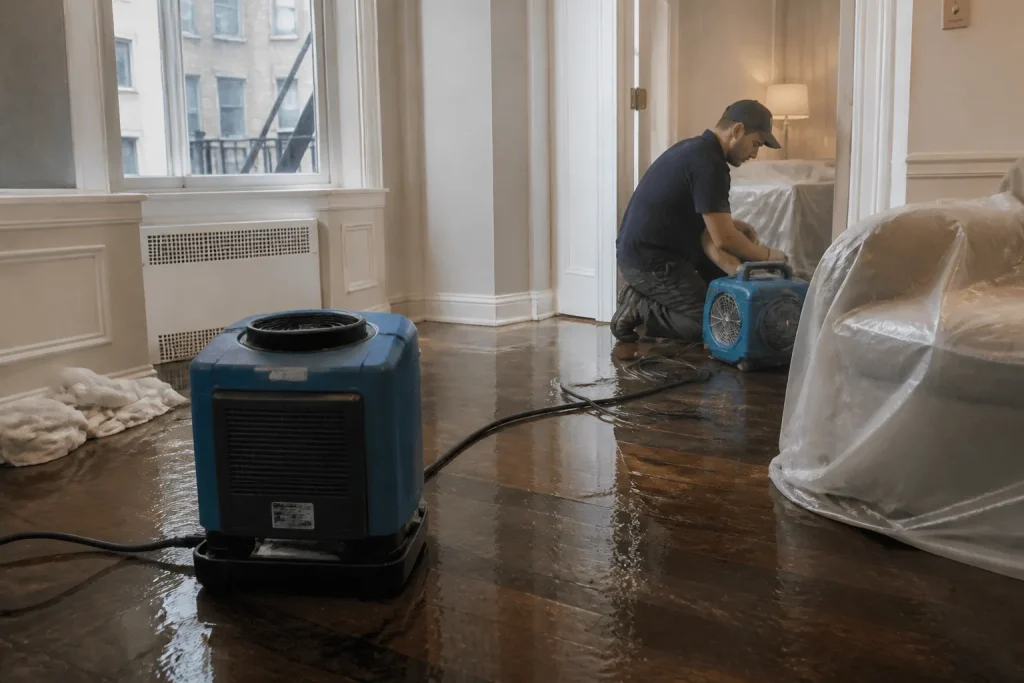
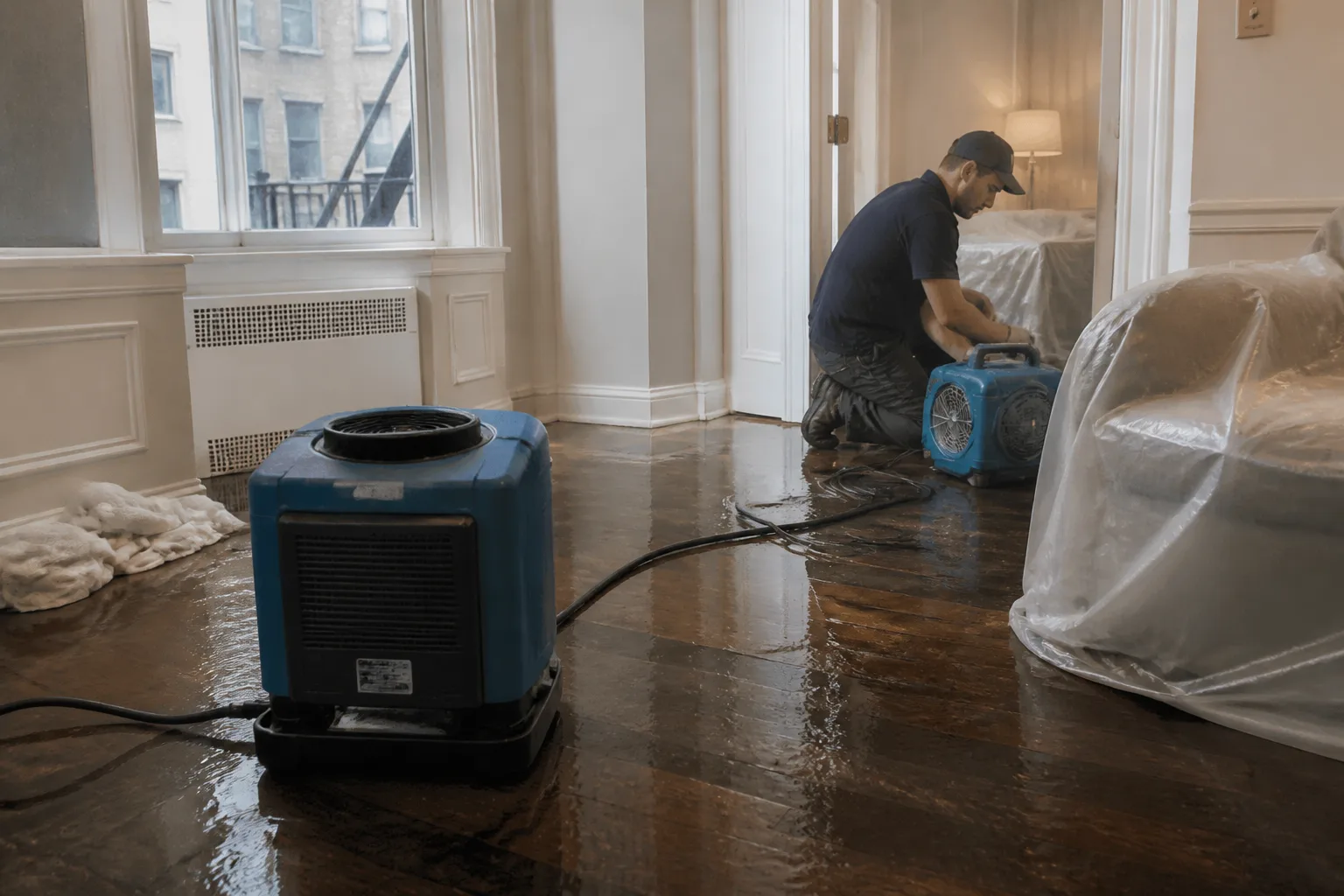
On West 79th Street, we regularly see clean water events from failed toilet supply lines in bathrooms and kitchen sink hoses. The damage spreads fast in pre-war buildings because original plaster walls wick moisture upward, and old-growth pine subfloors hold water longer than modern plywood. What starts as a small puddle becomes a $7,000 restoration once the plaster baseboards are opened up and the moisture map shows water moved three feet into the adjacent room.
Category 2: Grey Water
Grey water contains significant contamination and can cause illness if ingested. This includes water from washing machines, dishwashers, and sump pump failures. Upper West Side apartments with in-unit laundry see a disproportionate share of Category 2 events, and co-op boards are increasingly strict about how these are remediated because grey water in a shared wall affects neighboring units.
- Extraction, antimicrobial application, drying: $4,500-$7,000 per affected room
- With removal and replacement of affected flooring and baseboards: $7,500-$12,000 per room
- Upper West Side-specific factor: Board-mandated air quality testing after Category 2 work adds $400-$900 per test, and most boards require at least two tests.
Washing machine overflow in a pre-war Columbus Avenue co-op is the classic Upper West Side Category 2 scenario. The machine sits in a closet off the kitchen, the drain line backs up, and grey water flows under the original oak flooring and into the neighbor’s ceiling below. That’s not a cleanup. That’s a restoration with a board meeting attached.
Category 3: Sewage Backup and Black Water
Category 3 is the most expensive and most dangerous. This is water containing sewage, bacteria, and pathogens from toilet backups, city sewer line failures, or flooding from exterior sources. In an Upper West Side building with cast iron waste lines that are 80 to 100 years old, Category 3 events are a matter of when, not if, for many lines that haven’t been replaced.
- Full Category 3 remediation (extraction, controlled demolition, antimicrobial treatment, drying): $8,000-$15,000 plus rebuild
- Rebuild costs in Manhattan (drywall, flooring, paint, fixtures): $15,000-$40,000 depending on room count and finishes
- Pre-1980 asbestos testing mandate: $800-$1,500 when demolition is required, and if asbestos is found, abatement adds $3,000-$8,000 before restoration can proceed.
We pulled one out of a ground-floor unit near Amsterdam Avenue last February where a city sewer main backed up during a heavy rain. The water in the apartment wasn’t rainwater; it was everything the block had flushed that day. Category 3 work means full PPE, disposal of everything porous, and rebuilding from the studs. If this happens to you, don’t wait. Get a professional assessment immediately. Attempting to clean sewage water yourself is not safe, and no homeowner should be handling black water without proper protective equipment and containment.
Hidden Line Items Unique to Upper West Side and Manhattan Restorations
This is where most online cost guides fall apart. They quote national material and labor averages and ignore the line items that only exist in a Manhattan high-rise or a co-op governed by a board with maximum leverage. Here are the costs Upper West Side homeowners are most often surprised to see on a restoration estimate.
Board application and approval fees. Many co-ops and condos charge contractors to review insurance documents, alteration agreements, and work scopes before permitting any work. These fees typically range from $250 to $1,200, and they’re paid either by the homeowner or folded into the contractor’s quote. If a contractor hasn’t worked in your specific building before, expect this line item.
Certificate of insurance requirements. Buildings routinely require liability coverage of $2M or more, workers’ compensation verification, and specific endorsement language naming the building as an additional insured. Contractors who hold these policies pay higher premiums, and that cost is real. Contractors who don’t hold them can’t legally work in most Upper West Side buildings, full stop.
After-hours elevator surcharges. If water damage happens at 11 p.m. on a Friday, and the building’s freight elevator closes at 5 p.m. and doesn’t reopen until Monday, you have a choice: pay the after-hours elevator operator fee (typically $150 to $300 per hour) or wait. We answer our phones 24 hours a day and have a live dispatcher at 2 a.m., which means we can start the conversation immediately. But the building may still control the elevator schedule.
Asbestos testing in pre-1980 buildings. New York City requires asbestos surveys before any demolition or significant wall opening in buildings constructed before 1980. On the Upper West Side, that’s a substantial majority of the housing stock. The survey is mandatory, and if asbestos is found, abatement happens before restoration. There is no shortcut around this.
Protective floor covering and hallway protection. Boards and supers may require contractors to lay masonite or protective sheeting in building hallways and elevators. That’s $200 to $800 in materials per job, plus labor time. It’s a small cost, but homeowners rarely see it coming.
The 20-35% Cost of Splitting Extraction and Rebuild
Most restoration companies in Manhattan don’t rebuild. They extract, dry, and then hand the homeowner a list of recommended contractors for the reconstruction phase. On its face, that seems reasonable. In practice, it’s one of the most expensive decisions an Upper West Side homeowner can make.
When extraction and rebuild are split across two companies, you pay two mobilization fees instead of one. You pay for two site assessments, two sets of insurance paperwork, two board applications where required, and two supervising teams. The second contractor arrives on a job they didn’t scope, which means they spend their first day verifying the first contractor’s work, and some of that time gets billed back to the homeowner.
More expensive is the scope gap. The extraction company says the rebuild is not their problem; the rebuild company says the drying wasn’t done properly and they need to open the wall again. The homeowner stands in the middle holding two invoices and one wet apartment. In our experience, splitting the contract adds 20% to 35% to the total project cost in Manhattan, and most of that comes from duplicate mobilization and re-work on seams between the two scopes.
Floodline Restoration Co. does it differently. We handle extraction, drying, and rebuild with the same certified crew. The technician who reads the moisture map on day one stays on the job through the final coat of paint. There’s no handoff, no second mobilization, and no finger-pointing because there’s only one company standing in the room. If you’d like to understand what that looks like in a real Upper West Side apartment, call (845) 305-5737 and we’ll walk you through a recent project. Or start with our Water Damage Restoration in Upper West Side page for more detail on how we work.
What Insurance Actually Covers in 2026
Upper West Side homeowners fall into two categories: those in condos and co-ops with HO-6 policies, and those in townhouses with standard HO-3 homeowners policies. The coverage picture in 2026 is tighter than most people assume, and the most common surprises come from what isn’t covered, not what is.
Under a standard HO-6 condo or co-op policy, sudden and accidental water damage is typically covered. A burst supply line, a failed water heater, an overflowing bathtub. The damage to your unit’s interior finishes, from drywall inward, is generally your policy’s responsibility. The building’s master policy typically covers common areas, structural elements, and sometimes original unit finishes depending on the bylaws. Figuring out where the master policy ends and your HO-6 begins is a negotiation most homeowners get wrong on the first pass, and getting it wrong means leaving money on the table or paying out of pocket for what the building should have covered.
The three most common Upper West Side claims that fall outside coverage in 2026 are gradual leaks, seepage, and pre-existing conditions. A slow leak behind a bathroom wall that has been dripping for six months? Most carriers call that maintenance, not sudden damage, and deny the claim. Water entering through foundation walls during heavy rain in a basement-level unit? That’s seepage, and it’s excluded unless the homeowner purchased a specific endorsement. We’ve seen this conversation dozens of times, and the homeowner is usually sitting in a wet apartment when they learn the terms of their own policy.
Floodline Restoration Co. bills carriers directly, which means the homeowner isn’t playing messenger between us and the adjuster. We document everything from day one with moisture readings, photos, and a written scope, and we hand that package to the adjuster ourselves. If you’ve got questions about whether your specific situation is covered, call us. A fifteen-minute conversation with our team will tell you more than an hour with a policy document.
What the 90-Day Done Right Promise Means in Dollar Terms
Every restoration company will tell you they do good work. Almost none of them will put it in writing. Our 90-Day Done Right Promise, which we call the Keystone Standard, is a written guarantee tied to our K.E.Y.S. values code: Krafted right, Every time, Your home first, Standing behind it. If it’s not done right, we make it right. No paperwork battles, no arguing, no waiting for the claim to settle.
In dollar terms, that promise means this. If we dry a wall and it shows elevated moisture on a follow-up reading thirty days later, we’re back in to address it at no additional cost. If a section of baseboard we painted starts peeling because we didn’t prime it correctly, we fix it. If a rebuilt closet door sticks because it was hung out of square, we reset it. The homeowner’s cost exposure after closeout is zero, and that’s what it says on the paper we hand them when the job is done.
This matters more on the Upper West Side than almost anywhere else, because co-op boards scrutinize contractor work and because the cost of any re-work in a Manhattan building is higher than anywhere else due to elevator access and scheduling restrictions. A promise without a process behind it is a sales pitch. The Keystone Standard is a process.
When to Call a Professional
If you can see the water line on the wall, call. That’s the honest answer. The line the water left is where we start, and the longer it sits, the more it costs. Water moves through building materials at a rate most homeowners don’t believe until they see a moisture map. What looks like a two-foot damp patch on a wall in a Riverside Drive apartment is often a four-foot-by-six-foot affected area behind the drywall and under the floor.
Call us if you’re seeing any of these: a water stain that’s growing, a musty smell that appeared after rain, buckling hardwood, peeling paint near a bathroom or kitchen, or water in a ceiling below an upstairs neighbor. All of these are restoration situations, not cleaning situations, and the price difference between addressing them this week and addressing them next month is measured in thousands of dollars on the Upper West Side.
Related Services in Upper West Side
Water damage doesn’t stay water damage. If extraction and drying aren’t done properly, mold follows, and that’s a different category of problem with its own cost structure. If you’re seeing discoloration after a past water event, our Mold Remediation in Upper West Side team can assess the extent and advise on what’s actually needed. And if water damage came from a fire suppression system or a kitchen fire, the process looks different - see our Fire & Smoke Damage Restoration in Upper West Side page for how we handle combined damage. You can also always start at our Floodline Restoration Co. home page to get oriented.
What happens when you call
- 1
A real person answersNo phone trees - you reach a local pro.
- 2
You get an upfront price rangeHonest numbers before anyone is dispatched.
- 3
A background-checked tech heads outLicensed & insured, dispatched right away.
- 4
You approve before work beginsNothing starts until you say go.
The Bottom Line
Water damage restoration on the Upper West Side costs more than national averages suggest, and the reasons are structural: co-op requirements, elevator access, Manhattan labor rates, and the age of the building stock. A Category 1 clean water incident in one room realistically starts around $4,200 and commonly lands between $6,000 and $9,000 once rebuild work is included. A Category 3 sewage backup can pass $40,000 in a pre-war co-op with asbestos abatement and board-mandated testing. The best way to control costs is to hire a contractor who handles the full scope from extraction through rebuild, bills your insurance directly, and puts the guarantee in writing. If you’re on the Upper West Side and dealing with water right now, or you want a second opinion on a quote you’ve received, Floodline Restoration Co. offers free estimates. Call (845) 305-5737 and a live person will answer.
Frequently Asked Questions
Most Upper West Side water damage restoration jobs cost between $4,200 and $11,800 per affected room, with Category 3 sewage backups ranging from $15,000 to $40,000 including rebuild work. The exact figure depends on the water category, the building’s access rules, and whether asbestos testing or abatement is required. Call (845) 305-5737 for a free, specific estimate based on your building and situation.
Sudden and accidental water damage from burst pipes, failed appliances, or overflowing fixtures is typically covered under a standard HO-6 policy, subject to your deductible and policy limits. Gradual leaks, seepage, and pre-existing conditions are commonly excluded in 2026, which surprises many Upper West Side homeowners after a claim is denied. Floodline Restoration Co. bills your carrier directly and documents everything so the adjuster gets a complete picture from day one.
If water has penetrated drywall, flooring, or subflooring, cleaning is not enough. Moisture trapped in building materials leads to mold, structural deterioration, and odor problems that only get more expensive over time. A professional moisture assessment takes about an hour and tells you definitively whether you’re looking at a surface issue or a restoration job. On the Upper West Side, where walls are often shared and co-op boards require documentation, guessing wrong is expensive.
The cost difference comes from co-op and condo board requirements, elevator access restrictions and fees, Manhattan labor rates, pre-1980 asbestos testing mandates, and the cost of doing business with proper insurance and certifications in New York City. National cost guides rarely account for these factors, which is why their figures fall short of what Upper West Side homeowners actually pay. A contractor who has worked in the neighborhood understands these costs before the first piece of equipment arrives.
Written by Curt Bowman, Owner at Floodline Restoration Co., serving Upper West Side since 2010.
Need Damage Restoration Help?
Call Floodline Restoration Co. - licensed & insured, here with fast after-hours help in Upper West Side.
(845) 305-5737