
Emergency Water Damage Restoration Near Me: What Upper West Side Homeowners Should Do First
If water is spreading through your Upper West Side apartment right now, shut off the water at the source, cut power to affected rooms at the breaker, then call (845) 305-5737. The first 90 minutes determine whether you’re looking at a two-day dry-out or a six-week rebuild, and the difference usually comes down to what you do before the restoration crew arrives. If you’d rather not manage this alone at 2 a.m., we answer live around the clock.
Turning on a box fan seems like a reasonable first step when your bathroom floods at midnight. But if water has touched a wall cavity in a pre-war building with original horsehair plaster, you may be pushing moisture deeper into the structure and creating exactly the conditions the IICRC defines as a mold-risk environment within 48 hours. We’ve pulled apart enough lath-and-plaster walls on West 84th and West 103rd to know that what you can’t see is usually worse than what you can.
The First 90 Minutes: A Minute-by-Minute Sequence
The first 90 minutes are the only window where your own actions meaningfully change the outcome. After that, the water has found its way behind baseboards, under flooring, and into wall cavities where no homeowner can reach it. Here’s the order that protects both your structure and your insurance claim.
- Minutes 0-10: Stop the water. If the source is a fixture, a burst supply line, or an overflowing tub, find the shut-off. In most Upper West Side co-ops and condos, you have a unit shut-off near the bathroom or kitchen, usually behind an access panel or under the sink. A building-wide shut-off is in the basement and typically requires your super. Do not assume you know which valve is which; turning the wrong one can cut water to the apartments above or below you.
- Minutes 10-20: Kill the power to affected rooms. Water and electricity in old buildings with original wiring are a dangerous combination. Flip the breakers for the affected rooms only. If your breaker box is in a wet area or you can’t reach it without standing in water, do not touch it. Call your building’s super or an electrician.
- Minutes 20-35: Photograph everything before you touch anything. This is the step people skip, and it costs them real money. Your phone camera is the most important tool you own in the first hour. We’ll cover exactly what to document below, but the rule is simple: pictures first, moving things second.
- Minutes 35-50: Remove what you can safely lift. Small furniture legs, rugs, shoes, anything resting on the wet floor. Place the items on a dry surface, not in another room’s closet where they’ll trap moisture against a wall.
- Minutes 50-70: Call a restoration company with live dispatch. Not a call center. Not an answering service. We’ll explain how to tell the difference below.
- Minutes 70-90: Stop. Wait for the crew. Do not attempt to remove baseboards, pull up carpet, cut into walls, or run your own fans. This is where Upper West Side homeowners accidentally void coverage or worsen the damage.
What to Photograph Before You Touch Anything
Insurance adjusters work from documentation, not memory. Three categories of photos matter, and each serves a different purpose in your claim. We’ve stood next to adjusters in living rooms across the Upper West Side while they reviewed exactly these images.
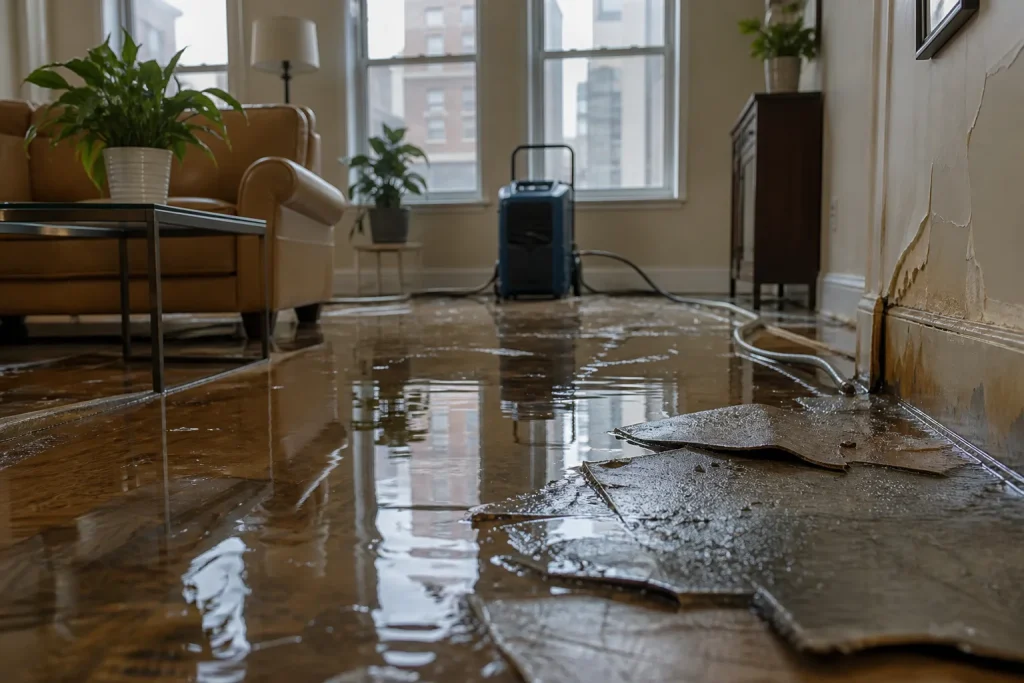
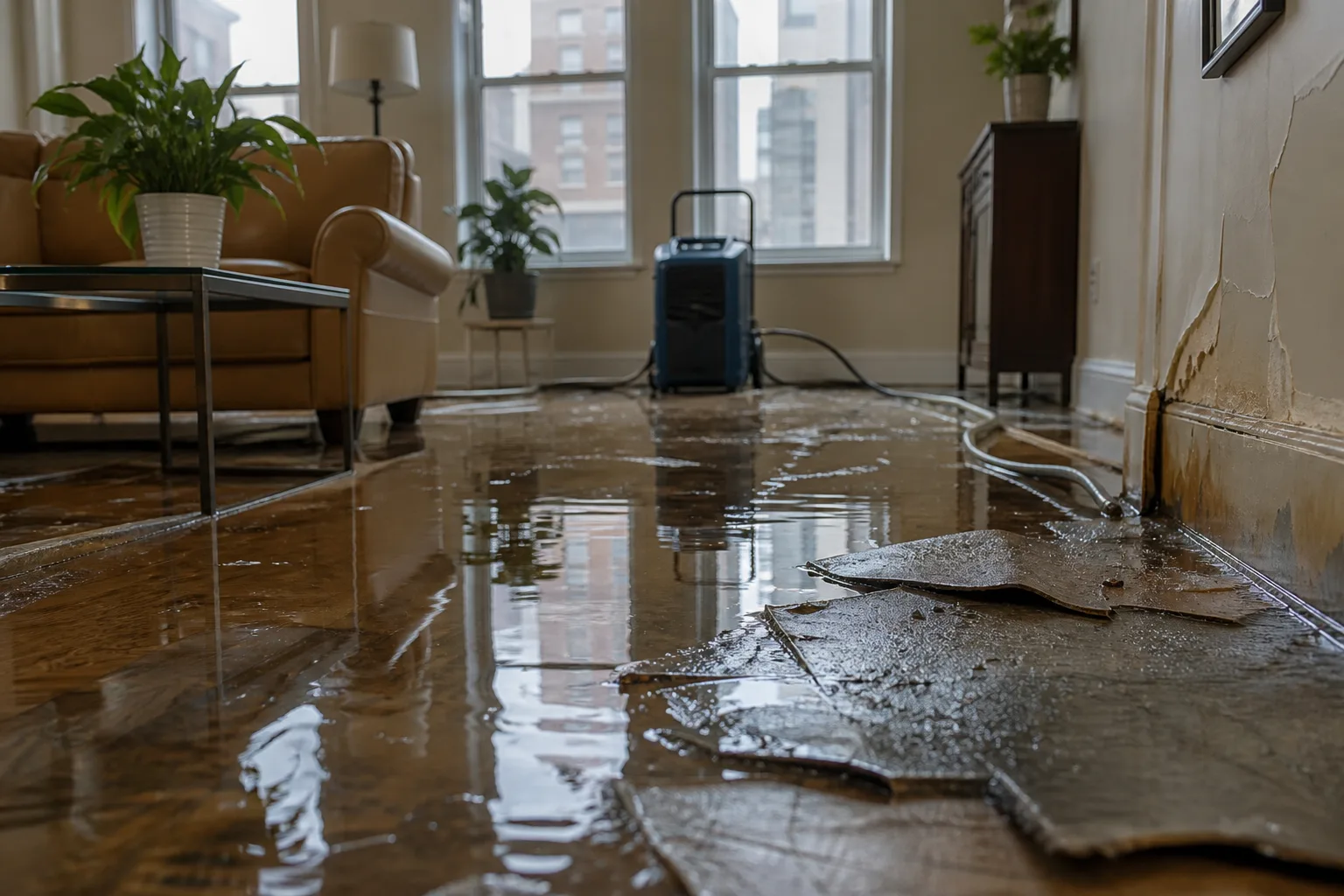
1. The water line on the wall. Water wicks upward through drywall and plaster. That dark line tells a story about how far the water traveled and how long it sat. Photograph it from directly in front and from an angle. Put a coin or a business card in the frame for scale. During extraction we mark the floodline with our moisture meters, and your photos become the baseline for the moisture log we hand you and your carrier.
2. The affected materials catalog. Walk the perimeter of the wet area and photograph every material that has absorbed water: hardwood flooring, baseboards, plaster, drywall, cabinetry, door frames. Open doors to closets that share a wall with the flooded room and photograph the interior wall. Water travels horizontally through shared stud cavities in pre-war construction more than most people realize.
3. The source of the water. Photograph the fixture that failed, the pipe that burst, the valve that leaked. If you’re not sure of the source, photograph the area where you first noticed water. Your insurance carrier classifies damage by water source (clean, gray, or black water), and the distinction affects both coverage and the restoration approach. Do not guess at the source in your documentation; let the photos show what they show.
Upper West Side Building Considerations: The Correct Notification Sequence
Living in an Upper West Side co-op changes the order in which you notify people. The sequence matters for your insurance claim, and doing it out of order can complicate things in ways that are hard to unwind.
First: your building’s super or managing agent. This is mandatory, not optional, and your proprietary lease or condo bylaws almost certainly require it before outside contractors begin work. The water in your unit may have already traveled to the apartment below, and your super needs to shut down any building systems that might be affected. In co-ops, the building’s master insurance policy may cover certain structural elements, while your individual policy covers your personal property and improvements. Your super’s incident report creates a paper trail that both policies will reference.
Second: your restoration company. The restorer documents the damage independently and begins mitigation. A legitimate company will coordinate with your super on access, equipment staging, and building-specific protocols like freight elevator reservations. In our 42 years of local service, we’ve never once been turned away by a super who wanted to see credentials and insurance certificates first. That’s a green flag; it means the building is protecting its residents.
Third: your insurance carrier. Here’s where many Upper West Side homeowners make the wrong call. If you call your carrier before a restoration company has documented the damage, you’re asking them to evaluate a claim from a description over the phone. By the time an adjuster arrives, the damage may have changed or worsened. A restoration company that bills the carrier directly and offers no-hassle upfront pricing can handle both calls for you, which is the route we recommend.
What “Emergency Response” Actually Means at 2 A.M.
Searching for “emergency water damage restoration near me Upper West Side” at midnight is not the time to discover that most “24/7 emergency lines” route to a call center in another state that schedules you for a callback in the morning. A legitimate emergency response from a restoration company means three specific things.
A live person answers the phone. Not a recording. Not a menu tree. A dispatcher who can make decisions. When you call Floodline at 2 a.m., a live person picks up. That person has access to the crew schedule and can tell you, in the same phone call, when a certified technician will be at your door.
A crew is on-site within two hours. “Emergency” means extraction starts the same visit. Not tomorrow morning. Not after the weekend. We dispatch from a board, not a sales desk, and the crew that arrives is the crew that’s certified to IICRC, RIA, and IFA standards. They walk in with commercial-grade extraction equipment, not a wet vac from a hardware store.
The job continues without a handoff. Some companies are really two companies: one that extracts water and hands you a bill, and another that does rebuild work and hands you a contract. On the Upper West Side, where apartment layouts are tight and building rules are strict, that split leaves you as the project manager between two crews, two schedules, and two invoices. We do it differently: the same Floodline crew that runs the Dri-Eaz extraction equipment on day one handles the daily moisture readings, logs the numbers, hands the log to you and your carrier, and rebuilds what needs rebuilding when the dry standard is met.
When Supposedly Simple Choices Go Wrong
We pulled a Phoenix LGR dehumidifier out of a West End Avenue apartment last winter where the homeowner had been running three box fans for four days before calling us because “the smell wouldn’t go away.” The fans had been pushing moisture into the wall cavity behind the sofa, and the original baseboard had swollen one-sixteenth of an inch beyond its paint line. That’s the kind of detail that turns a three-day dry-out into a two-week mold remediation job.
Here’s what never to do when water is in your home:
- Never run box fans or household dehumidifiers. They stir surface air and push moisture deeper. Professional drying involves negative air pressure, containment, and precise airflow calculations.
- Never lift wall-to-wall carpet. The pad underneath may be saturated and pulling at the carpet delaminates the backing. The result is a carpet that can’t be salvaged.
- Never drill holes in walls or ceilings. We hear this one a lot: someone read online that “ventilation holes” help. Drilling into a wall cavity without knowing where your wiring runs is dangerous, and you’ll likely make the cavity harder to properly dry.
- Never use a household steam cleaner or shop vac on a sewage backup. Black water contains pathogens. No consumer-grade machine is designed to handle it, and you do not want aerosolized sewage in your apartment.
- Never skip the photos because you’re embarrassed. We’ve heard homeowners apologize for the state of their apartment. Don’t. The photos are evidence, not a housekeeping scorecard.
How Floodline’s Direct-Billing Process Changes the Sequence
When we show up on the Upper West Side, our crew documents the damage with the same three photo categories you captured, then adds professional moisture readings mapped room by room using Dri-Eaz, Phoenix, XPOWER, B-Air, and Injectidry equipment. Those readings get logged daily until the dry standard is met. You receive the log. Your carrier receives the log. Nobody has to play messenger.
Then the billing happens directly with your insurance company. You never front the money and wait for reimbursement. You never sit on hold with a carrier trying to explain what a “category 2 water loss” means. And you never get stuck between a restoration company and an adjuster arguing about scope. Our 90-Day Done Right Promise means the work is backed in writing. If it’s not done right, we make it right. No paperwork battles. No arguing.
The line the water left on your wall is where we start. Everything from extraction to final paint is handled by one company, one crew, one point of accountability. For a homeowner on the Upper West Side who’s been burned by a contractor before, that’s the square deal.
What to Do If You’ve Already Waited
Maybe the leak happened on a Tuesday and you’ve been running a dehumidifier since Wednesday. Maybe you’ve been waiting for your super to “take a look.” Maybe you didn’t want to bother anyone. Here’s the plain truth: after 48 hours, the conditions for mold growth exist in any absorbed porous material. After 72 hours, the risk curve steepens. After 96 hours, you’ve likely moved past simple water damage into the territory where Mold Remediation in Upper West Side becomes the only path.
The damage has not stopped spreading while you waited. It has been traveling through the wall cavity, wicking up the plaster, working into the subfloor. The fix is almost never a bigger fan or more patience. The fix is a professional moisture assessment and a drying plan executed with commercial equipment. We’ve done this work on West 72nd, Riverside Drive, and Amsterdam Avenue, and the pattern is always the same: the sooner the crew starts, the smaller the the job ends up.
Key Takeaways
- The first 90 minutes are your window. Use them in order: stop the water, kill the power, photograph everything, remove loose items, call a live dispatcher.
- Photograph the water line, the affected materials, and the source before anyone moves anything. These photos are the foundation of your claim.
- In Upper West Side co-ops, notify your super first, then your restoration company, then your carrier. The order matters.
- “Emergency response” means a live person at 2 a.m. and a crew on-site within two hours. Anything less is a scheduling service.
- Never run box fans, lift wall-to-wall carpet, or drill into walls yourself. You’ll likely make the damage worse.
- A restoration company that bills your carrier directly and logs moisture readings daily removes you from the middle of the claim.
The Bottom Line
Water spreads whether you’re ready or not. The question is whether you call someone who can stop it tonight or someone who puts you on a list for tomorrow. On the Upper West Side, where the buildings are old, the walls are thick, and the clock is working against you, the answer to “emergency water damage restoration near me” is a company that answers the phone with a live person and gets a certified crew to your door within two hours. If water is in your apartment now, call (845) 305-5737 for a free estimate and same-day response. If you want to understand your broader options before an emergency hits, see our full service pages for Floodline Restoration Co. home, Water Damage Restoration in Upper West Side, and Fire & Smoke Damage Restoration in Upper West Side.
Frequently Asked Questions
How fast can someone actually get here?
If you call Floodline at any hour, a live dispatcher answers and can usually have a certified crew on-site within two hours. We don’t route to a call center or schedule for tomorrow. Call (845) 305-5737 and you’ll get a real person who can tell you exactly when the crew will arrive.
Will my insurance cover water damage restoration?
It depends on the water source. Sudden and accidental events like a burst supply line or an overflowing tub are typically covered. Gradual leaks that went unaddressed for weeks are often not. Your documentation in the first hour matters more than you think. We bill the carrier directly and handle adjuster communication, so you’re not left explaining technical details to someone over the phone.
Do I really need full restoration, or can I just clean it up myself?
If water reached baseboards, walls, flooring, or any porous material, professional drying is almost always necessary. Surface cleanup cannot reach moisture trapped inside wall cavities or under flooring, and those hidden pockets are where structural damage and mold begin. A moisture assessment costs nothing and tells you the real scope.
What does the 90-Day Done Right Promise actually mean?
It’s a written guarantee tied to our K.E.Y.S. values code: Krafted right, Every time, Your home first, Standing behind it. If the work isn’t done right within 90 days, we make it right. No paperwork battles, no arguing. We hand you the guarantee in writing when the job starts.
Do you work with my building’s co-op or condo board?
Yes. We coordinate with supers and managing agents on the Upper West Side routinely, including freight elevator access, insurance certificate requirements, and building-specific protocols. Your building’s rules don’t slow us down; we handle them as part of the job.
Written by Curt Bowman, Owner at Floodline Restoration Co., serving Upper West Side since 2010.
Need Damage Restoration Help?
Call Floodline Restoration Co. - licensed & insured, here with fast after-hours help in Upper West Side.
(845) 305-5737